Two New Yorkers spend six months 18 months!?! in Bangalore and other places in India.

Showing posts with label wine time. Show all posts

Sunday, December 30, 2007

Wine Time 18: Flamingo Chenin Blanc

Flamingo Chenin Blanc 2005
380 rupees
14%

Yet another wine we drank a while back. It was hard to be thrilled by it. It had a nice, sweet, honey-like frangrance, but the taste itself was way too sweet for us. Not so memorable. We have to give it a 5 for being boring.

Wednesday, December 26, 2007

Wine Time 17: Sula Blush Zinfandel

Sula Blush Zinfandel
Rs. 395
12% alcohol

As usual we drank this entry before we could take a picture, so I don't have any photographic evidence of its orange-red, tawny color, perhaps its best aspect. The smell was pleasing -- subtle and fruity, but quick to evaporate. It's not very deep, but it doesn't have anything unpleasant about it either. It's an insubstantial, fruity, fun wine. We give it a six, and we say drink it when you feel frivolous.

By the way, this wine recently one a bronze medal at the India Wine Challenge.

Monday, December 24, 2007

Wine Time 16: Sula Brut


Sula
410 rupees
11.5% alcohol

Christmas and (even more to the point) New Year's are right around the corner, and for some people that means a flute of sparkling wine. If you're going for real, honest-to-goodness French Champagne in India, be prepared to pay through the nose --- at least 1200 rupees, and possibly closer to 3000 inr ($75). At prices like that, you'd best make your parties on the small side (maybe just two -- or one!). One of the major English-language papers was recently trying to convince that simply tons of Indians are guzzling down champers every chance they get, but I think it's safe to say reports of Champagne dancing off of shelves are highly speculative.

Luckily, Indian sparkling wines options are readily available, and these include the Vinsura we drank a while back as well as this entry from Sula. They're hardly cheap, but they do start looking reasonable compared to the French stuff.

So how did this one do? It's good, it's nice, it's dry. There's a slight, hard-to-pin-down aftertaste (grass?) that not so great, but not terrible either. It reminded us a little of the Spanish sparkling wine Freixenet -- maybe a little boring, but still a good standby. I'd rate it slightly better than the Vinsura, with a 7.5 for overall goodness. I'd like it even better at 300 rupees, but it's still a reasonable deal at its current price. At least with Sula rather than Moet et Chandon, you can invite more than just yourself to the party . . .

Wine Time 15: Sula Chenin Blanc


Sula
2007
395 rupees
12.5%

This wine is semi-dry, which for secret Wine Expert reasons actually means "slightly sweet." I'm sometimes a little leery of such wines, because I think a bad sweet wine can be awful, much less bearable than a bad red wine.

Anyway, this one is really, really good. It smells a little like honey, a little like flowers. The flavors are clean, crisp, and not overpowering. We thought it was very tasty. An 8.

Wednesday, December 19, 2007

Wine Time 14: Bluefolds Shiraz redux

We already did this wine, but it found its way back into our house all the same. It seemed like a 5.5 last time, but maybe it's a little better than that. How about a 6? It's still thin and kind of dull, but it did improve once we left it open for a while and let it breathe.

Tuesday, December 18, 2007

Wine Time 13: Seagram's Nine Hills Shiraz

Seagram
465 rupees
13.5% alchohol

I usually keep the empty bottles of wine we've drunk until their contents either get written up here or we've completely forget what exactly the wine was like. I'll try to clear up the backlog, and then at least the apartment will stop looking so much like a frat house.

Here's another wine from Seagram's relatively new Nine Hills line. We reviewed the Chenin Blanc a while back.

Well, we thought this was a good everyday wine, but it's not going to amaze you. It had a very pleasant, smooth, fruity taste, and it was fairly full-bodied and balanced. It other words, it didn't taste like watered-down juice and it didn't have any particular overwhelming taste -- I think most people who like red wine would find this pleasant.

And it also happens to go well with the spicy dark taste of plumcake -- and that's a big plus at this time of year. So we give it a 7.5.

Thursday, November 22, 2007

Wine Time 12: Bluefolds Shiraz

Blue Star Agro & Winery, Pune
Rs. 437

Another one from the maker of Evita, covered yesterday. According to the wine label, this is a "deep purple full-bodied" wine with "an attractive aroma of black pepper with silky tannins that leave a delicious finish" It also goes with tandoor items and "spiced Indian curries." (We thought that bit was funny -- where are the unspiced Indian curries? And curries is kind of vague -- almost like saying "goes with entrees.")

The wine smelled not so nice, a little like rubber (can I just call this sulphur? Maybe). The wine was very thin, and the taste disappeared quickly. It just didn't have much staying power, and shiraz is usually a very muscular wine. We weren't wowed -- 5.5.

Dr. Rathore's notes for a 2004 Syrah earn a rating of VERY GOOD -- he says that the Bluefolds lines are "some of India's best wines." "Syrah" is just an alternate spelling for the same grape as Shiraz, so I guess Blue Star has changed its product's name for some reason. Either way, I'd like to try this one again to see if I might have gotten a bad batch.

Wednesday, November 21, 2007

Wine Time 11: Evita Ruby Red

Blue Star Agro & Winery, Pune
Rs. 274
2006


This wine is described as "fruity, dry, light, and stable," with a "distinctive bouquet." It's also made from "classic grape varieties," but those are not named. It's also called a "value-for-money" wine that's ideal with "cheese and meat dishes."

Don't cry for me having to drink this wine, because it was decent. It seemed to us a little like a beaujoulais nouveau -- it was drinkable, very light, fun, without much complexity. The only weird thing was a kind of odd smell, a little like rubber or something. But it wasn't bad, all in all. We give it 7.5, with an extra half point for the under-300-rupees price.

Interestingly, Dr. Rathore says that this is one of "Blue Star's cheapest, and doesn't really warrant attention." The 2004 version got an average rating. I think it's a bit better than average -- perhaps it's improved.

Sunday, November 18, 2007

Wine Time 10: Vinsura Vineyards Brut Sparkling Wine

Vinsura Vineyards
Brut sparkling wine (methode champenoise)
Sankalp Winery
501 rupees
12.5 % alcohol

Recently I stopped in at the new and fancy Food World Gourmet, which attempts to give expats and other rich and high-living people all the stuff they want. It feels weird going there and looking at overpriced imported grapes from the USA (and nothing domestic!) and so on, but on the other hand it's great to know where to go when you really really want some OK mayonnaise, for instance. Anyway, the store also has a pretty decent liquor store attached, and this bottle comes from there.

Don and I disagreed about this sparkler. I thought it had a weird grassy smell and a slightly off aftertaste. There also were just not that many bubbles -- I think if you're shelling out for bubbly, then it really ought to have lots of bubbles. Here not so much.

Don, on the other hand, thought it was decent though too expensive -- noticeably better than Marquise de Pompadour, probably the major champagne-ish Indian wine.

Overall, we give this a 6.5. I do think it's overpriced for what it is, but it is a reasonable alternative to buying Champagne or other foreign sparklers here, a very pricey proposition. (Also, the label is very nice -- good use of gold-leaf leaves.)

Sunday, October 28, 2007

Wine Time 9: Seagram Nine Hills Chenin Blanc

Seagram
Rs. 415
12.5% alcohol

As we continue to clear the decks with bottles we've drunk recently, we come to the second of the Seagram's wines we've tried out.

It was a bit of a surprise -- I had it in my mind that chenin blanc was a very mild, sometimes almost watery wine. But this was a concentrated, quite sweet, slightly bubbly wine. It was tasty and fun. We completely randomly had it with masoor dal (yellow lentils with lots of spices), and that's not what this wine is for. As the label says rightly, it will "pair well with [light] salads and appetizers." Actually, we think its sweetness might not even work for many appetizers -- this would probably be nicest as a dessert wine, or something to sip with a biscuit. It would be a good wine to drink on most occasions when you'd be drinking champagne.

It's a solid 7.

Wine Time 8: Grover Cabernet-Shiraz

Grover Vineyards
Rs. 380
12% alcohol

Business-oriented people in India often talk about the USP (unique selling proposition) of a business, and it's common to see "USP" this and "USP" that in the newspapers. It may not be unique, but the selling proposition trumpeted on this wine's label is the fact that its shiraz and cabernet sauvignon vines were "imported from France" and are now "thriving" on the "sunny hill-slopes of the Nandi Hills near Bangalore." So you've got a little foreign flavor in these one, perhaps.

We liked this wine. It's a very standard, full-bodied red wine. Let it breath a little by leaving it open for a few minutes before drinking. It's going to go well with meats and other heavy dishes -- we ate it will some vegetarian chili and it was a good match.

This 2007 bottle gets a 7.

Thursday, October 18, 2007

Wine Time 7: Madera 2006 White Wine

Nashik Valley White Wine
Sula Vineyards
Rs. 272 ($6.70)
12% alcohol

In our last edition of wine time, we had the surprisingly not-horrible Madera red, which got a respectable 7. And now it's time for the white.

Well, the label's still nice! Thrifty Sula didn't even bother to round up a different tribal-art picture for the white. And the tag line on the back ("an easy-drinking wine from the Nashik Valley, India's premium wine-growing region") is also the same. That's what I call efficiency. Or maybe laziness. Whatever. It saved me from taking another photo.

On to the drinking. Yuck. It's thin, it's slightly sweet, it tasted a little like an overripe melon. It was the sort of wine that would give you a terrible terrible headache if you drank too much of it at a small-gallery opening, the end of a wedding reception, a party at my house, and wherever else plonk is likely to be served. It seems to us that if you're making an entry-level wine, which I guess is what Sula is going for, you better make it extra enjoyable. Maybe not great, but fun. Or you're going to have a lot of people thinking that wine sucks and that a certain very predictable and less over-priced beverage is the only way to go when it comes to alcohol.

This wine is a 3.95, with 0.05 subtracted for the the fact that it costs 2 rupees more than the red version (huh?). The best part about it is the bottle, which is making a handy watering can at the moment.

As for the Complete Wine Guide, Dr. Rathore gives the 2004 edition a very low AVERAGE score. His "tasting" description is wonderfully disgusting: "a bit slimy, saliva, some lime peel, dull sweet finish."

Sunday, October 14, 2007

India Getting on the Wine Map

A lousily written article in the Telegraph points out that the new edition of the World Atlas of Wine will now include wine-producing areas in India as well as China: "The map of the world's most renowned wine-producing areas has been officially redrawn this weekend to include countries such as China, India, Georgia, Canada, New Mexico and Belgium."

Now, New Mexico is not a country, and Georgia may or may not be, depending on which one the book includes. More odd is the claim that Canada is a wine newbie. They've been producing lots and lots of good wines, especially on the west coast, for some time.

Anyway, if I see this book in India, I'll have to peek inside to see which wines in the subcontinent made the cut. I hope I can lift it -- as the article says, it used to be 236 pages, but now it GROANS under the weight of its 400 whole pages.

[via Fark]

Monday, September 17, 2007

Wine Time 6: Madera 2006 Red Wine

Nashik Valley Red Wine
Sula Vineyards
Rs. 270 ($6.70)
12.5% alcohol

I was momentarily confused when looking over my notes on this wine. "Ghee, vinegar, onion, curry leaves" were all scrawled down. God, just what (and how much) were we drinking that night? But then I realized that this was just an old shopping list, and our actual, highly authoritative wine notes were on the back. (Note to wineries: "flavours of ghee" would look nice on a wine label. Just a thought.)

Speaking of labels, it's clear that the Madera label is designed to tell you that there's nothing fussy inside. The only wine talk on the back says "an easy-drinking wine from the Nashik Valley, India's premium wine-growing region." Nothing about the grapes themselves, which implies it's a blend from many varieties. And the art on the label is especially nice: it's inspired by the artwork that tribal groups do in the Warli region, in Maharastra, the same state the winery is in.

And the wine? Not bad. Fruity, pleasant. It's the kind of wine that would be good for sangria or sipping on a hot day. OK, it's one-dimensional, and the taste disappears quickly, but it's still fun and good. We give this a final score of 7, which includes a half-point bonus for its non-ridiculous price of 270 rupees.

I see that an anonymous commenter said in an earlier post that we should run away from Madera: "Yecch!" Maybe we lucked out, because I thought the bottle we had was very drinkable. But Anon. is in good company: The Indian Wine Guide says that the 2004 version of this wine tasted "watery, acidic, flabby, sulphuric, and unpleasant." Ouch! I think it's gotten better than that.

Wednesday, September 12, 2007

Wine Time 5: Vinsura Cabernet-Syrah Red Wine

This is another wine made in the Nashik Valley, about 230 km (150 miles) northeast of Mumbai. The label calls it a "complex deeply colored wine with good body, tannins, and aromas. The taste and flavours may be reminiscent of dried fruit, juicy black-current, savoury spice and gamy meat [!]. The wine can be best enjoyed with roasted pork, turkey, lamb, venison, and Indian Chinese cuisine."

I love how Indian Chinese just gets thrown in at the end as an afterthought. Instead the list starts with an animal that very few people in Indians eat, even if they are non-vegetarian, and then a bird that's also pretty rare (except for expat holidays), lamb (not unknown, but not that common either), and then Bambi. Don thinks that whoever wrote the copy just tried to come up with unlikely and fancy-sounding meats for the list. But why not caviar? Or the finest ham from Spain? Or that party gimmick dish the turducken?

But back to the wine. The good news is that we did NOT taste any gamy meat. But the bad news is that this wine is just OK. It was fairly oaky and somewhat astringent. Don thought it had a bitter aftertaste. Overall, just kind of boring and one-dimensional. It's a 5. The The Complete Indian Wine Guide doesn't say anything about this particular wine (it probably wasn't out yet), but the author is pretty bullish on the winery's future. This one still needs a little work, we think.


Finally, here's a sexy photo. It's from Vinsura's site, next to the statement that "We ensure Competitive Pricing, Reliable service and deliveries." Has this lady just finished dropping off a case, perhaps via water? Or has just perhaps just finished drinking a glass? Our wine label said the wine was best served around 18 C (64 F), and it does look as if it might be kind of chilly wherever this picture was taken.

Thursday, September 06, 2007

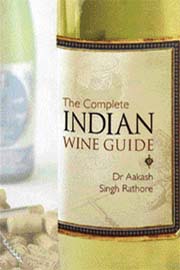
Complete Indian Wine Guide


We'll have another of our very casual (some might say half-ass) Wine Times coming up soon, but in the meantime here's a book that treats Indian wine seriously and covers it in a systematic matter -- Dr. Aakash Singh Rathore's Complete Indian Guide, which came out last year. I just got it today, so I've just flipped through it, but it will be very useful. The author checks out all the major wineries in India -- about 20 when the book went to press.

Being so thorough has its dangers, at least for the writer and his tasting apparatus. Here's what Rathore says about the smell of the 2002 Riesling put out by Bosca Wines: "foul, green, and alcoholised." Taste? "Repulsive." As for the winery itself, it's "possibly India's worst" and a "tragedy." And he doesn't even get through all their offerings. How's their 2002 red? "There is really no point in going through the tasting process with this. It will be just as bad as the others, and I am afraid to try it just from the look of it."

If that's not news you can use, then I don't know what is. I'm looking forward to seeing how this guide's ratings compare with our own amateurish ones.

Another Indian-wine book probably worth checking out (I haven't yet) is Wine Wisdom, by the wine columnist and sommelier, Magandeep Singh.

Sunday, September 02, 2007

Wine Time 4: Seagram Nine Hills Shiraz

This wine cost 465 rupees and was a 2006 vintage. It couldn't be any earlier, because Seagram only started making Indian wine since last year. They do already have a big Indian presence with liquor brands here. Seagram's also owns Jacob's Creek in Australia.


The shiraz tasted very jammy, with a slight aftertaste that wasn't good but also wasn't that strong. The label calls it medium-bodied, but I would say it was pretty big and bold. Would be good with tomato dishes and meat. 8 out of 10.

(Here's a rough map showing where exactly in India the Nashik valley is.)

Tuesday, August 14, 2007

Wine Time 3: Chantilli Cabernet Sauvignon

A bit of a surprise. I bought it at the store on a whim, mainly because its label didn't look that annoying, and because I didn't have enough rupees for a fancy-pants reserve wine that was shinier. But we lucked out, because it was actually darn good.

Our wine was bottled in 2005 and cost 368 rupees ($9). It's from Chateau Indage, a winery that began in 1982, and the grapes are from the Sahyadri Valley, in Maharashtra.

The first thing we noticed about this wine was the strong smell of alcohol -- you get a hit of that, and you also get a hit of the slightly sweet smell (like toast) of the oak barrels it was aged in. As for taste, it's dry, but you can also taste a lot of the fruit. For once, I agree with the wine label: there really were "rich aromas of ripe fruit, plums, cherries, and green pepper." (I didn't taste any green pepper, and that's just as well.)

This is a big wine, and I'm not sure how well it would work with lots of Indian food -- I think it would clash with all the strong flavors in a lot of dishes. We had it with some pizza, and that seemed a good fit. It would also be good with a burger.

A good wine! We give it a 7.

Saturday, July 21, 2007

Wine Time 2: Grover's La Reserve

In our second Wine Time feature, we decided to take the advice of a commenter and get some La Reserve, Grover Vineyards' premium product. The company describes it as coming from "vines imported from France, [which] are now thriving at our vineyards on the sunny hill-slopes of Nandi Hills near Bangalore, India. This fine red wine is a blend of [80%] Cabernet Sauvignon and [20%] Syrah [aka Shiraz] grapes. Aged in French oak barrels, it has a luscious bouquet of fruit and spices with a distinctive oaken flavour. Ready to enjoy immediately. La Réserve only improves with age."

Our bottle was of a 2005 vintage, bottled last month. We have bought this wine several times before, and I (but not Don!) remember it as being much better.

Like the Shiraz, it was one dimensional, with an overly sour taste. The taste disappears very quickly, so it doesn't work as a big wine, which I think is what they're going for. The main taste was sour, and the ending was slightly tannic, but not in a good way. I guess that was the French oak talking.

I would still consider getting La Reserve again, in hopes that my memory didn't mislead me, and that other vintages of the same wine are better. At some point (I can't find the actual article), Decanter magazine judged La Reserve the "Best New World Red Wine." Maybe there's hope. If India can be part of the New World, then who knows what other wonders are out there?

Where it probably couldn't complete is in an open or semi-open marketplace, because of its price. This wine cost 475 rupees ($12) -- given its quality, that's a real reach. If we had bought a similar wine in New York for $12, we'd have expected a lot more from it.

On a scale of 1 to 10, we give it a 5. It's OK, but just barely.

Monday, July 16, 2007

Wine Time: Grover's Sante Shiraz

Selling and making wine is seen as a growth industry in India. All you have to do is to pick up just about any issue of a magazine or a newspaper's lifestyle section to be confronted with claims that more and more wine is being guzzled like crazy.

The reality is completely different. Wine can hardly help being a growth industry since there's so little of it drunk. As the Outlook article below states, "per capita consumption [of wine] is a mere six ml, compared to China's 300 ml." It's not just that a tiny proportion of the population drinks wine. It's that the tiny proportion of the population that can 1) afford such luxuries and 2) cares to drink actually drinks wine. Imported wine remains very expensive, primarily because of duties (although they are going down somewhat), and the wineries in India are still by and large quite new, with all the growing pains that that implies.

But all that being said, there are more and more domestic wines being bottled every day. As our humble service to you, we thought it would be fun to review all the Indian bottles that come through our door.

First up is a wine from Grover Vineyards, whose winvery is right here in Bangalore. We had their 2006 Santé Shiraz, priced at Rs. 275 (about $7) and bottled in 2006. The label actually listed a price of Rs. 225, but the clerk told us that it had mysteriously gone up. We didn't protest too much, but we hadn't tasted it at that point.

This is not good wine -- too sour. The label claims that there are those wine clichés of "black pepper and blackberries" inside, but if there were, the sourness keeps them well hidden. On a scale of 1 to 10, I give it a 4. Do not drink, except in an emergency situation.