Two New Yorkers spend six months 18 months!?! in Bangalore and other places in India.

Friday, March 31, 2006

They're Here

Books from home
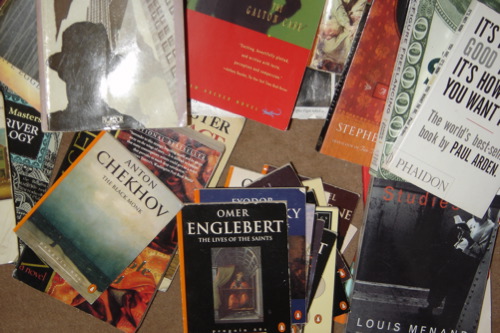
The day before we flew from New York, the day we had about 20 much more important things to do, I took a taxi to the post office and mailed myself two boxes of books using "M bags." This obscure method is only for printed matter, and not all post office branches even have these magical bags. The post office took my boxes, threw them into Tyvek sacks, and then attached a label with a big M on it. It cost $60 to mail the two heavy boxes, so it was a steal. Because all the guidebooks say that Indian mail is unreliable, I decided to consider the postage gambling money more than a sure thing.

The books only took about a month to get to Bangalore from NYC, but for various reasons they bounced around to several different locations before turning up at Don's office this week. As you can see, the books I thought were good India choices are a mix of Penguin 60s, crime novels, and ginormous classics that I somehow never found the time to read in NYC. And self-improvement titles like "Get to Know Your 401(k)" and "Six-Figure Freelancing." Because there's nothing like one sunny day after another to make books like that irresistible. And of course some novels set in India, including Passage to India and Vikram Seth's enormous A Suitable Boy.

(For the record, I haven't had any trouble with things not arriving from the states, but aside from these books, I've only gotten personal mail. Our friend did have several things disappear between London and Bangalore, though.)

Bananas Foster

Bananas Foster
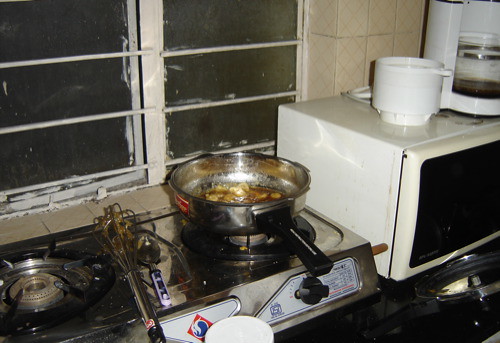
We had an exciting cooking revelation a couple days ago. If you're making bananas foster and you use ghee (clarified butter) rather than the normal butter, the sauce becomes solid, almost like taffy. You can see that it clogged up our whisk.

For rum, we used the local brand, Hercules XXX Premium. It's fine, but definitely the best part about it is the XXX in its name.

Not sure if I've shown the kitchen before, but the two burners run on propane -- you can see the hose to the side. Hardly anyone has an oven here.

Wednesday, March 29, 2006

The 'Stache

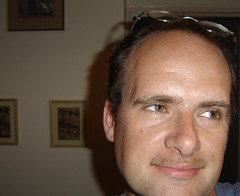
DSC01928.JPGSince we've been in Delhi, I've been growing a small mustache. It just seems like the right thing to do -- Indians guys, especially those in the south, LOVE their facial hair. I've never had one before, so it's looking weird (and lopsided) right now. It's also coming in a lot lighter than my hair, so I doubt that many Indians are impressed.

The mustache project was inspired by our former next-door neighbor Duncan. A colleague of Don, he helped us so much in our first days here, and was also great fun to know. While we knew him here, he sported a mustache of his own. Now that his India stint is over and he's gone back to London, it seems important to make sure the mustache at least remains. I'm not sure if he's left his own alone or what.


In other news, tomorrow is Ugadi, the Hindu New Year in this part of India. It's a pretty religious day, as far as I can tell -- I think we'll be celebrating by going shopping.

Thursday, March 23, 2006

Peeved Tourists

Peevish Tourists
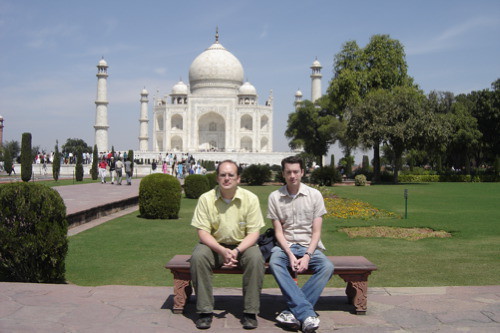
I can't believe how pissed-off we look. It's a four-hour drive from Delhi to Agra, where the Taj Mahal is, so it's not as if we were all fresh and dewy at this point. We hired a car and driver, and a guide got thrown in also. His pushy manner had started to wear on us by now. He seemed to get antsy whenever we started to get interested in something. It was right about when he took this picture that he started yelling at some Japanese or Japanese-American tourists who were videotaping the Taj. Our butinski guide claimed it was against the rules. I never got to the bottom of whether or not videotaping the Taj is an offense, but I wish that he'd let it slide.

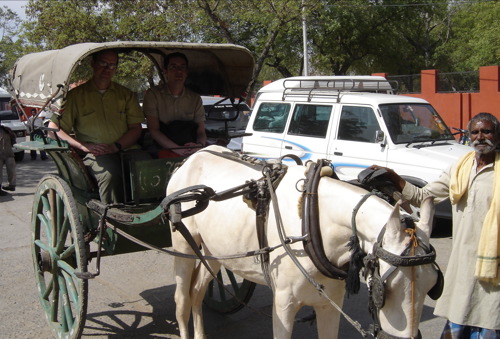
Seriously, though, we did have a really great time. So good a time that I'm going to wipe from my memory the large sums we gave to look like dorks in the tonga. You'd think we were headed to our own public execution judging by that expression I have (on the left).

Tonga

Thursday, March 16, 2006

Holi Aftermath

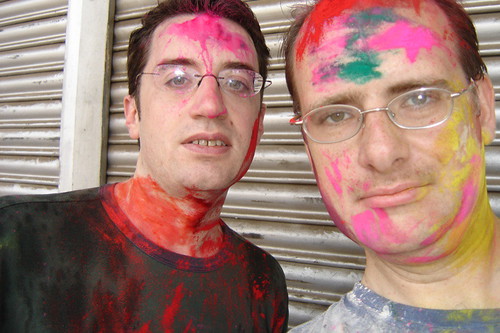
John and Don
We had a great time at Holi. Our hotel is in a sedate kind of town, near embassies and places like Unicef, and institutions like that don't seem to go in much for flinging color around, at least in public. Walking up the street, we were followed for a while by some little kids who were red, green, and blue, but they weren't quite brave enough to catch up with us (maybe I should say that at that point we were too scared to let them catch up with us).

Finally we boarded a autorickshaw and went up to Old Delhi, which is a lot more packed with people and storefronts. All the stores were closed, but there were lots of people running around. Mostly teenage boys. Very few women, since they tend to get harassed on this holiday. We were prime targets, as the picture above shows. The holiday began to run down around 2pm, and stores started opening up again around then.


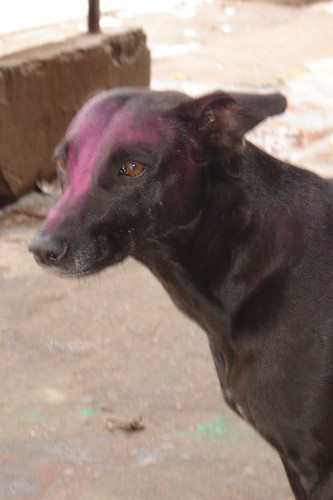
Even a dog or two got color:
Holi dog


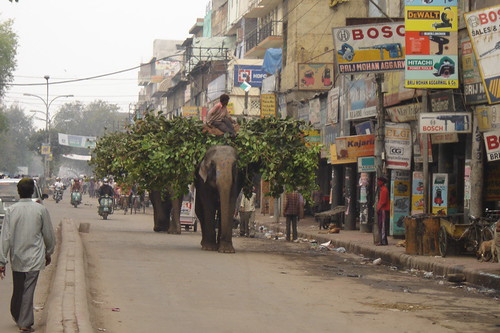
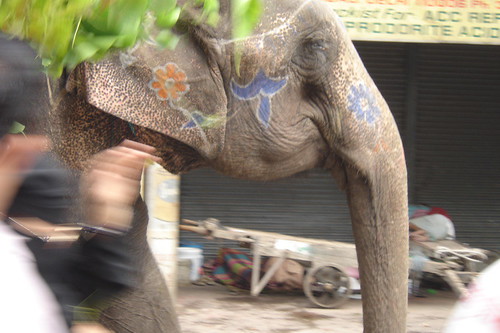
And we also finally saw some elephants. They were carrying brush and seemed to be working rather than appearing as part of Holi. They had some nice designs, but no color.

Elephants


Elephant on Holi

More of our Holi pictures are here.

Tuesday, March 14, 2006

Holi

Tomorrow is the main day of Holi, a crazy holiday whose main activities include throwing colored water and powder on people and generally being on less than best behavior. It's a much bigger deal here in the north of India than it is back in Bangalore. Don's office is closed, and we understand that buses, etc., won't be running until the festival dies down around 2 pm or so. We're looking forward to checking it out from a semi-safe distance. We do expect to get a little color thrown on us, but we definitely won't be getting into the middle of it.

(I also wrote a post about Holi over at Jaunted.)

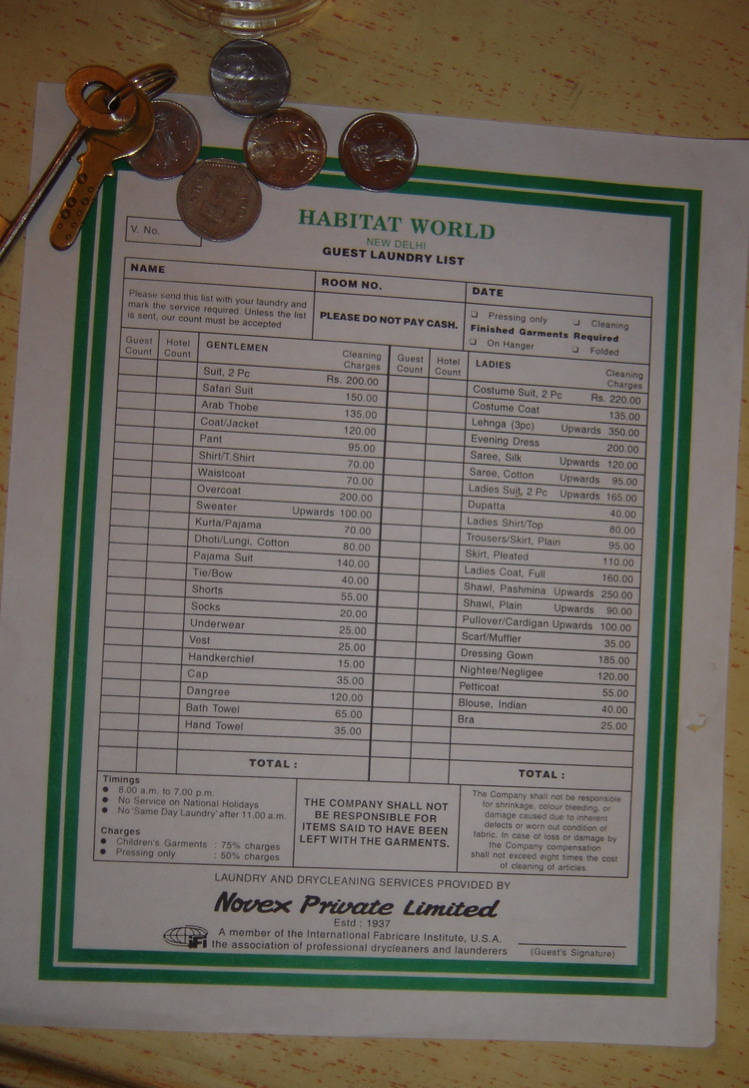
Laundry List

Laundry List
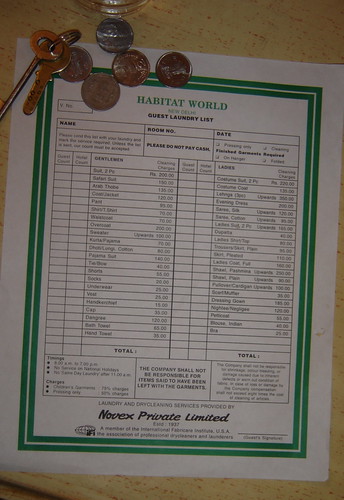
We've moved to a new hotel, since the other one had lots of street noise and was far from the thick of things. Habitat World, the new hotel, is kitty-corner from UNICEF, and it seems to have lots of conference-goers and such among the guests. As you can tell from the laundry list, the hotel is also prepared for just about any outfit you could throw at it, although we're not sure what a burka or chador would be categorized under. You can go here for a larger version of the list.

Monday, March 13, 2006

Quick Judgments

For what it's worth, here are our first impressions of Delhi. This is definitely the big city -- a little more like New York than Bangalore. Lots more bookstores, since it's India's center of publishing. It seems louder, although maybe that's because our hotel faces the Ring Road highway. Prices are slightly higher. The rickshaw drivers want more money and are less willing to bargain. Every single one of their meters are broken -- no idea how that happened -- so it's a little hard to know what a "fair" price is. The hotel is in Lajpat Nagar, in South Delhi, so the touristy places are a great distance away.

I walked through Connaught Place on Saturday and felt completely drained by the end. Designed by the Brits to be enormous and impressive and ROUND, this complex of stores forms a bulls-eye that every tourist must evitably head toward. Little kids who want to shine your shoes, craft store owners who would like nothing better than to drop what they're doing and 1) tell you not to drink the water (good to know!), 2) show you where the tourist office is (it's where the maps say it is) and 3) . . . maybe you'd like to look at some crafts? And of course other people whose may have just been friendly. In the end I collapsed in the arms of an old friend, the Barista coffee chain, and sat listening to a Canadian guy explain to his dehydrated girlfriend the wonders of Edward Said. That didn't exactly perk me up, but the coffee did.

Delhi Belly Strikes

Well, Air Deccan did all right by me, with a flight that came and went on time. An amazing lack of legroom, and you had to buy even your coffee on the flight, but it worked out OK. The most entertaining part was staring at the mosquitoes circling around me and everyone else at Bangalore airport. They're not nearly as lively as North American mosquitoes, but they are persistent.

Don had a semi-bad arrival. His flight was delayed by 5 hours because of another plane's mechanical problems. (There's only one runway at Bangalore.) He got in at Saturday night, and then we went out for Chinese. He was very sick for all of Sunday. It's not clear if it was something he ate or not, since I was fine. Anyway, he's on the mend now, and going into work for a half-day.

We're at a very moderate hotel in South Delhi, which is way the heck away from most touristy places. I'm writing this using the hotel's slowish dialup, and will soon be off in search of WiFi.

Friday, March 10, 2006

Off to Delhi

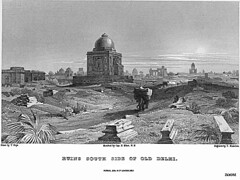
Ruins south side of Old DelhiDon's work has asked him to go to Delhi for a week and a half, so we're flying out tomorrow. His work's paying for his flight, so he's on Jet. I'm flying a much cheaper competitor, Air Deccan, which is supposedly always late! Maybe that's why his flight was more than twice as expensive as mine. It'll be fun to compare notes once we've both arrived.

Interestingly, Indians pay less for flights on most domestic flights -- Don's ticket cost about $200 more because of his foreign status. Air Deccan doesn't charge the extra fee.

Domestic airlines have been popping up like crazy in India in the past few years, and it's a little overwhelming. The discussion thread on the topic at India Mike was very useful for getting a handle on all the options.

Monday, March 06, 2006

Down on the Plantation

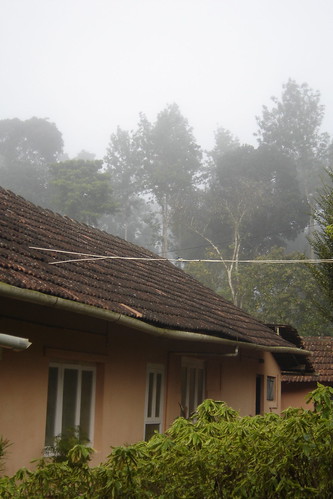
Foggy Morning
Last week, we had plans to visit the ancient Hindu temple ruins at Hampi, said to be one of the greatest sights of India, and relatively close to us. But we waited too to make our arrangements and the train sold out. So we decided to strike out for another famous district in our local state of Karnataka: Coorg, a mountainous region known for its warlike tribal inhabitants (conjectured to be descended from fifth-century Roman mercenaries fleeing the collapse of the empire) and for its coffee trees, which thrive on Coorg's misty hillsides. Several coffee plantations have accommodations for paying visitors. Our travel agent recommended one, gave us a bus ticket, and sent us on our way.

Getting to the bus was the first adventure; it was slated to depart at 6 a.m., which means we had to find a rickshaw at about 5:15. It's still pitch black at that hour here, and the streets of Bangalore are nearly deserted from about 1 a.m. until sunrise. So as we set out, it was just us, a couple of shifty looking characters eyeing us appraisingly, and several none-too-friendly street dogs. It wasn't looking good, but finally a rickshaw came rattling past and saw a good opportunity to make some easy money. We were happy to pay about two and a half times the normal fare to the bus station (we gave him 80 rupees, or about two dollars). But the adventure did not end there. The Bangalore bus station is vast and poorly marked; most states have their own bus line, and each one operates out of a different section of the sprawling complex. We wandered about in the predawn haze for a few minutes before some kind person directed us to an unpromising-looking corner that turned out to be exactly right. Before long we'd found our bus, a "semi-deluxe" model that featured limited legroom, extremely dirty windows, and no a.c. However, before the end of the weekend I'd look back on this coach as the pinnacle of comfort.

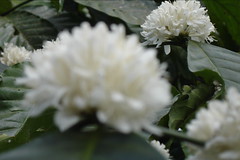
Six hours and only one bathroom break later, we arrived at Virajpet, the end of the line; from here, we took a rickshaw about half an hour up into the hills and into the middle of nowhere. Naturally the driver was unsure exactly how to get us where we were going, but after only a little uncertainty we found the plantation: Alath Cad, just outside a tiny town called Ammarathi. The property consists of the farmhouse, a large modern house built in the traditional Coorgi style, which features tile roofs similar to those you see on Mediterranean villas; the old farmhouse, which is now the main building of the bed and breakfast; a cottage, which is where we stayed; and 75 acres of coffee trees planted in neat rows. The air was clean and cool; the coffee trees were in bloom and giving off a very heady and powerful fragrance reminiscent of orange blossoms or jasmine; all you could hear were the sounds of crickets, frogs, and birds. In short, it exactly the opposite of every part of India I had seen so far, and thus perfect for a weekend away.coffee blossom

The place was very much a working plantation in the feudal style. The plantation wife, Mrs. Moorg, greeted us very hospitably and then handed us over to two of her retainers, a husband and wife team who look after the guest house. This couple, their children, and some other dependents of the plantation were housed nearby, and we saw many of the workers going about their daily tasks. Mrs. Moorg retreated to her porch, where she sat drinking cool beverages and gossiping with a neighbor. The retainer couple took excellent care of us, first by settling us into the cottage (which was very simple, no tv and only intermittent electricity) and then by preparing an excellent homemade lunch, the first of a series of truly memorable meals we were served here. (The local cuisine features a lot of black pepper and mustard seed, and is unusual among regional Indian cuisines in that pork is a prominent ingredient.) The rest of the afternoon we spent hiking through the coffee trees. They have to be kept shaded, so taller trees are planted along the rows; on these trees, black pepper vines are cultivated, creating a second cash crop without much extra effort.

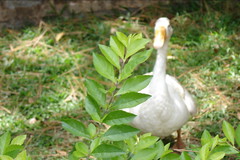
Coorg Goose.JPGThat evening we retired early and slept like logs; the next morning and early afternoon we lazed around, John reading and I doing a little work I'd brought from Bangalore. Butterflies and birds kept us company, as did a small gaggle of domestic geese who noisily made their way around the buildings as they grubbed for roots and bugs. Too soon it was time to go back to the bus station; we loaded up our bags with the ground plantation coffee and whole peppercorns they sell, and waited for the rickshaw to come pick us up. Mrs. Moorg graciously invited us up to her porch to sit while we waited; we chatted with her and her husband for a few minutes about the coffee business. They grow robusta beans, which are exported to Europe for blending; the coffee mostly available for sale in India is imported from Vietnam.

The bus ride back -- how to describe it? Well, let's just say that no "semi-deluxe" coach was available for the return trip, so we had to make do with a bare-bones, economy-class Indian bus, the kind most travel guides strenuously warn you against. We were packed in rather tightly, to put it mildly, and the shock absorption capability of the bus was more or less nonexistent. At first it was kind of fun, like being on an amusement-park ride, but by hour two it was getting awfully old, and by hour three, when we had to change buses in Mysore, I was keeping an eye out for any old semi-deluxe coach headed to Bangalore, ready to pay any price. No luck, though -- it was another cattle car that was headed the way we wanted to go, so we slurped down a quick coffee and wedged ourselves in.

The important thing is that we made it home in one piece, and that we had a great weekend in a beautiful setting. What's more, we can feel adventurous for braving the Indian bus system in two of its less tourist-oriented forms. However, I'll freely admit I'm looking forward to our next journey (which is a work trip to Delhi) not least because the mode of transport will be business-class air travel.

Friday, March 03, 2006

Money Wants to Be Spent


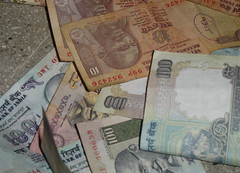
Rupee Notes
Originally uploaded by jrambow.
Obviously, with our American dollars, we have a lot of relative wealth here. One unexpected complication, though, is that often the money that the ATMs spit out is too large to spend on everyday items. I'm talking about things like autorickshaws (most trips cost about 20 rupees), street food (around 10) and chai (5), and for small tips and such. Fifty rupee notes (about $1.10) are hard to use for things like these, 100 rupee notes very difficult, and 500 rupee notes just about impossible for many types of shopping. (There are 1000 rupee notes, but I haven't seen one yet. I don't know what I'd do with one if I had it, either.)

The ATMs usually deal in 100s and 500s, so you have to buy something immediately if you've let your hoard of 10s and 20s vanish by then. A friend of ours has taken to buying little 15- or 30- rupee items at the government-run crafts store specifically to turn his bigger bills into smaller ones. Obviously, the clerks there aren't happy about giving up their supplies of 10s and 20s, but so far they've had enough to hand out -- a lot of mom-and-pop places simply don't. The supply of smaller bills isn't large enough to match the need for them.

Tuesday, February 28, 2006

Indian Food at Jaunted

Over at the travel blog Jaunted, I'm doing a weekly post on Indian food. Here are the ones so far:


Any suggestions for next week and beyond?

Monday, February 27, 2006

Making Headlines


Don and John
Originally uploaded by jrambow.
A friend emailed us this cover from last Wednesday's New York Post.

Thursday, February 23, 2006

A Night at the Hookah


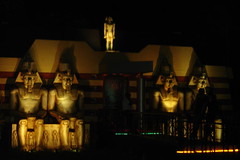
Hookah Nightclub
Originally uploaded by jrambow.
During our visit to Mysore last weekend, we met up with an acquaintance staying there for yoga training. He very kindly took us to what's just about the only nightclub for miles around. The Hookah! As you can see from the photo, this Egyptian-themed place is completely awesome. It's part of Planet X, a big sports complex on the outskirts of town. The place also has a large restaurant, drag racing, a bowling alley, and other stuff. Because the place is a little far out, we had to pay a largish rickshaw fee, which included the driver waiting around for us.

Outside the grand entrance to the club, a large sign said "positively no stags," but since our friend Ray knew the doorman, we all got in. Admission was steep, at 400 rupees, but it was good against food and drink. Inside, the Egyptian theme was in full force, with a big sarcaphogus-head for a DJ booth and hookahs.

After a bit, the doorman came up to me and asked me not to take any pictures inside, since he'd seen my camera. Having dancing going on is not exactly encouraged in this area, and it's kind of amazing that there is one at all. Being away from the main drag may have helped.

The small-but-impressive dance floor was packed with what Don said may very well have been the coolest kids for 100 miles around. The music was pretty good -- a mix of hip hop, bhangra, some older alternative music, and, of course, Bryan Adams, who is very big in India (he played Bangalore and Mumbai a couple weeks ago). We were some of the smattering of whites there, but there were also a half-dozen of so black people -- surprising, since I've seen maybe four in my three weeks in Bangalore. I couldn't think of any polite way to ask, but I was wondering where they were from. Ray talked with one of them and solved the mystery. Despite the Yankee caps and athletic gear they were wearing, they were South African college students studying in the area. From the sounds of it, they were a little homesick.

We'd gotten there around 10:15 or so, so it was already approaching the bar's closing time. In Mysore (as in Bangalore), it's at the no-so-wild hour of 11:30. Don and I decided that we had better get another drink to try to recoup some more of that 400 rupees. We ordered two brandies -- it seemed like a good idea at the time. The bartender, who looked as if he was about 16, said what we thought meant that they had no brandy, or maybe just not the brands on the extensive drinks and food menu. First Don and then I gave him our respective tickets anyway, since it wasn't clear what the deal was. I asked for brandy a few more times, for good measure, and the bartender looked at me a little strangely. We weren't exactly heartbroken, but it was a letdown that we'd handed over our soon-to-be-worthless tickets over nonexistent brandy.

At just about 11:30 on the dot, two heaping plates of rice appeared, with forks sticking out of them. Brandy, biryani (the rice dish they'd made), it probably does sound pretty much the same when a remix of "Summer of '69" is blasting in the background and the menu contains so many possibilities.

We all laughed, we couldn't help it, but mostly I felt bad that someone had spent the time cooking up dishes that we definitely couldn't eat at that point. We did manage to get all that rice wrapped to go. Since we were leaving tomorrow, we gave the heavy containers to the rickshaw driver when he dropped us off at the hotel, so hopefully all that biryani didn't go to waste. And that was our big night out in Mysore.
Wednesday, February 22, 2006

Autorickshaws Rule Our Lives


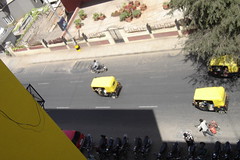
Autorickshaws from Balcony
Originally uploaded by jrambow.
One of the most important parts of day-to-day life here are the small, three-wheeled autorickshaws that putt around all over. Most (or all?) of them in Bangalore are powered by LPG, liquid petroleum gas, which is a mix of propane and butane (it's the same thing our kitchen stove runs on, by the way).

The autorickshaw driver sits in front and drives an engine that's about as powerful as a scooter. The back passenger bench holds about three people in a pinch, or two of them with packages. (If you're talking about little kids, then rickshaw capacity is much, much higher.) Everything's covered over with a bright yellow vinyl cab.

All the rickshaws have meters that are supposed to be used for every trip. Here in Bangalore, the first kilometer costs 10 rupees, and after that it goes up by half-rupees in little clicks. About 75% of the time, the driver refuses to turn on the meter and will want you to pay a set amount to take you to your destination. This amount, of course, is higher than the metered rate would be, with a hefty tip thrown in. The willingness to bargain over the fee and come to an agreement depends on how willing you are to bail and to wait for another rickshaw to come putt-putting down the road. One of our more idealistic guidebooks claims that all locals insist on using meters, and so should tourists. I'm pretty sure that plenty of locals are also paying set fees, albeit ones that are less than mine. Anyway, the point is you can't always get the guy to turn on the meter.

If the meter's off, we always haggle over the price, although that's usually only good for a reduction of 10 rupees. A surprising amount of time, rickshaw drivers don't want to bargain, and we have to wait for another. That's OK, there often seems to be about one rickshaw for everyone in town. (If you later catch your driver bragging to another driver when they're stopped at a light about how much he's charging for the ride, then you didn't bargain hard enough. Not that something so embarrassing ever happened to us . . . .)

If you're going to haggle, it helps to be sure that the driver and you both have the same destination in mind. Street names are not always useful, probably because we often mangle the pronouciation. Landmarks are better, but it can sometimes be hard to know what qualifies as a landmark. Rickshaw-worthy landmarks are not necessarily the same things that maps or tourists think are important. Saying that we want to go to the War Memorial circle, which looks prominent on maps and is a busy intersection, is always met with a blank stare. The Indian Express newspaper building always works, and that makes sense. But Kids Kemp, a local department store, is also good, and I'm not sure why.

All the books warn about drivers that will encourage you to go to craft stores -- they get a commission from the owner for bringing in fresh rubes. Only one driver's tried this with me so far, although I don't mean to minimize the danger. I can think of few things worse than being taken to look at crafts against your will.

Monday, February 20, 2006

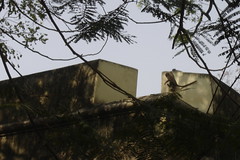
Monkey Baby on Ledge


monkey on ledge.JPG
Originally uploaded by jrambow.
This monkey was playing on the outer wall of the Maharaja's Palace. A few seconds before this shot, we were treated to a live demonstration by two consenting adult monkeys that showed how baby monkeys are made. We chose not to get that shot.

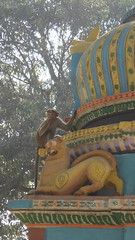
Monkeytown, India


monkey on shrine
Originally uploaded by jrambow.
It's a little embarrassing that we had to leave town to get a photo of a monkey, but them's the breaks. This Mysore monkey was really into running up and down the shrine, which was close to the Maharaja's Palace. Sure he looks cute, but now that we've seen the creatures in action (stealing things, jumping at ladies and making them jump in return), we're a little less pro-simian than we were before.

Friday, February 17, 2006

No tansas tangas, no bullocks, no pushcarts

Here's a sign near a big intersection on Cubbon Road. Tansa evidently means horse or horse cart, but I couldn't find much on the web. (Update: That's because the word is actually "tanga" -- see comments.)

The covered wagons, which are drawn by small, perky horses, are often painted with flowers and other designs -- I'll try to get some examples. Both the tansas tangas and the bullock carts are used for hauling cargo like pipes, vegetables, stones, etc. I'm not exactly sure why they're outlawed on Cubbon Road. It is a wide, divided road, so maybe cars want to be sure to be able to go fast. In the background you can see a couple autorickshaws speeding away.

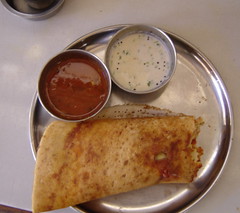
Success


Success
Originally uploaded by jrambow.
Here's the dosa I got once I had the local restaurant's system down. Note the bite marks -- I was too hungry to snap the photo immediately. More about dosas later.